

How much should a small business budget for digital marketing? A common starting point is a percentage of revenue: research cited by the U.S. Small Business Administration found companies spent an average of 7.9 percent of revenue on marketing, ranging from 6.3 percent for B2B product companies to 11.8 percent for B2C service companies. For a business with $500,000 in yearly revenue, that average works out to about $3,292 a month. This guide from AIG Web Methods explains where those numbers come from, what the money actually buys, and how to adjust the figure for your own industry, location, and goals in the Philadelphia area.
What the Data Says About Marketing Budgets
The most useful public benchmark comes from an article on the U.S. Small Business Administration blog (Rieva Lesonsky, July 9, 2019). It notes that many businesses set a marketing budget as a percentage of revenue, and that startups can use projected revenue instead. It then cites 2018 research from Web Strategies showing average marketing spending of 7.9 percent of revenue, broken down by business type:
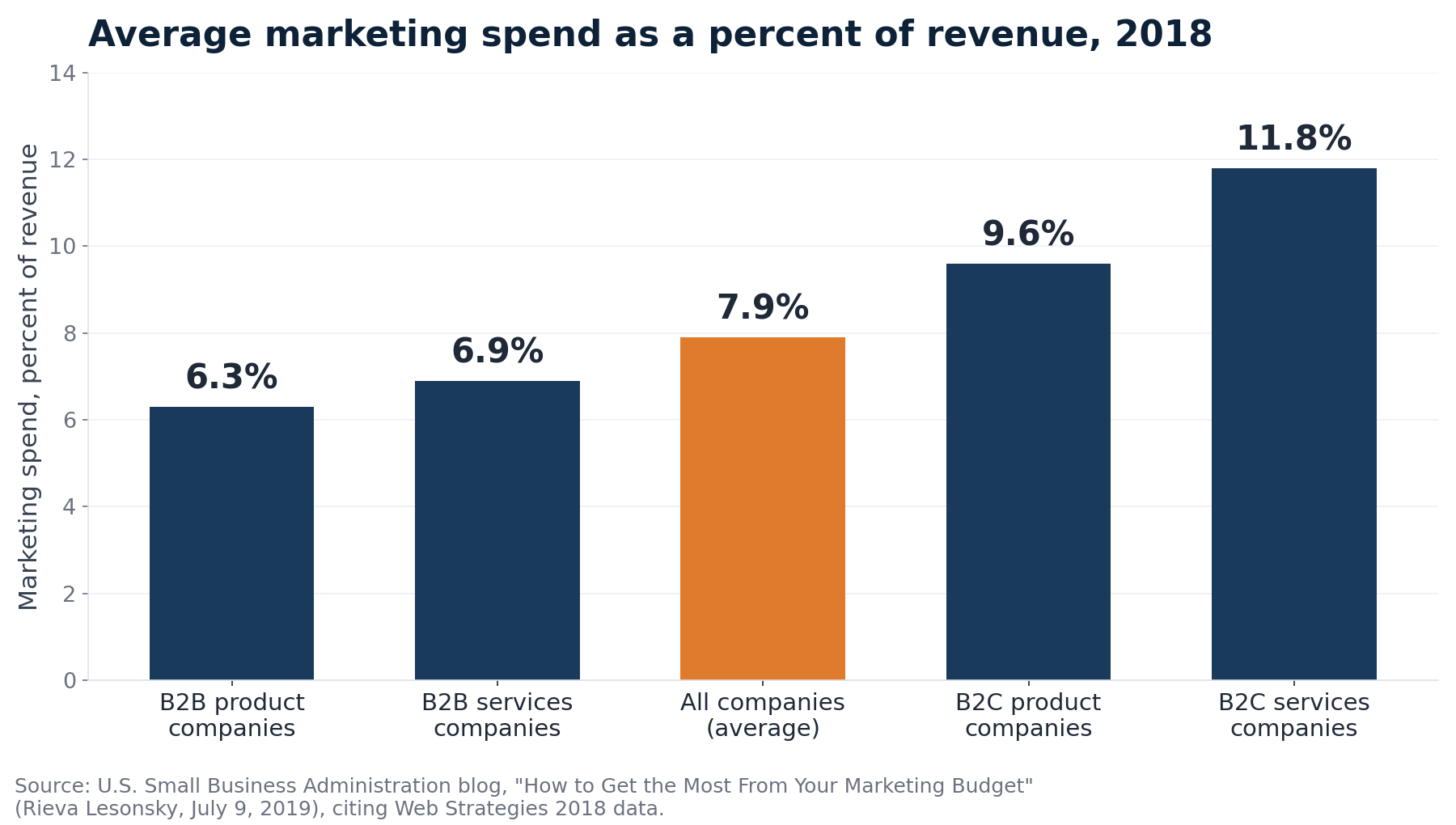
Two things stand out. Businesses that sell directly to consumers spent more than businesses that sell to other businesses, and service companies spent more than product companies in both groups. A home services company or a dental practice sits in the B2C services column, which is the highest bar on the chart. The same SBA article also cites a separate figure for advertising alone of 1.08 percent of revenue on average, which is a reminder that paid ads are only one slice of a full marketing budget.
Be honest about the limits of these numbers. They are averages from 2018 research, they cover all marketing and not only digital, and they are not a rule the SBA sets. Use them as a sanity check on your own plan, not as a target to hit exactly.
What That Looks Like in Dollars
Here is what those percentages mean at three revenue levels. Monthly figures are the yearly amount divided by twelve and rounded to the nearest dollar.
| Yearly revenue | At 6.3% (B2B product) | At 7.9% (average) | At 11.8% (B2C services) |
|---|---|---|---|
| $250,000 | $15,750 a year, about $1,313 a month | $19,750 a year, about $1,646 a month | $29,500 a year, about $2,458 a month |
| $500,000 | $31,500 a year, about $2,625 a month | $39,500 a year, about $3,292 a month | $59,000 a year, about $4,917 a month |
| $1,000,000 | $63,000 a year, about $5,250 a month | $79,000 a year, about $6,583 a month | $118,000 a year, about $9,833 a month |
Those totals cover everything: your website, search visibility, ads, reviews, and follow-up. The point is not to hit an exact percentage. It is to treat marketing as a planned, recurring cost rather than something you think about only when business slows down.
Why There Is No Single Right Number
A dentist in Huntingdon Valley, a plumber in Bucks County, and an online shop that ships nationwide are not competing for the same customers, the same keywords, or the same attention. Their marketing needs differ, so their budgets should too. These factors move the number up or down for any business:
- How competitive your local market is, meaning how many other businesses are chasing the same customers online
- Whether you want to grow fast or keep the customer flow you already have
- How much of the work you do in-house versus pay specialists to do
- Whether your current website and Google Business Profile are a strong foundation or need rebuilding first
- Your average customer value, since a business with a high-value service can justify spending more per lead
The Line Items in a Digital Marketing Budget
“Digital marketing” covers several distinct services, and your budget should account for each one rather than treating it as one lump sum. Common line items include:
- Website design and hosting. A site that loads fast and works on mobile phones.
- Local SEO. The ongoing work of ranking for “near me” searches in your service area.
- Google Business Profile management. An outdated or unclaimed Google Business Profile costs you customers before they ever reach your website.
- Paid advertising. Google Ads and similar platforms, where you pay per click and can turn results on or off quickly.
- Social media management. For businesses whose customers pay attention on Facebook or Instagram.
- Review generation and reputation management. Reviews shape how a business looks in Google Maps and search results, so a steady flow of new ones matters.
- Marketing automation. Automatic follow-up texts, appointment reminders, and review requests that save staff time and recover business lost to a missed callback.
A business that skips one of these, such as a well-designed website with no local SEO behind it, often wonders why the site “isn’t working,” when the real issue is that nobody can find it.
How Industry and Location Change the Math
A business in a dense metro area like Philadelphia and its suburbs competes against more businesses per search than one in a small rural town, which generally means more effort is needed to stand out in local search and map results. Service businesses with high customer lifetime value, such as home improvement contractors, medical and dental practices, or law firms, can often justify a higher spend because one new client is worth a lot over time. That matches the chart above, where B2C service companies spent the largest share of revenue. Retail businesses with thinner margins per sale need to watch return on ad spend closely and may lean harder on organic search and reviews than on paid ads.
No benchmark replaces your own numbers. Ask two questions: what does a new customer cost you now, and what is a new customer worth to your business over a year?
The Cost of Doing Nothing, or Doing It Yourself
Many owners handle marketing themselves before hiring anyone, which is a reasonable place to start. But be honest about the cost. Every hour spent updating a website, posting on social media, or replying to reviews is an hour not spent on the work that brings in revenue. A Google Business Profile untouched for months, or a website not updated in years, quietly loses ground to competitors who stay active. Doing nothing is not free. It shows up later as fewer calls, fewer bookings, and lost visibility that is harder to win back than it would have been to keep.
AI Search Optimization: A New Line Item
Search itself is changing. People now ask tools like ChatGPT, Perplexity, and Google’s AI Overviews for business recommendations, not only type keywords into a search box. If your business is missing from those answers, you are invisible to the people who ask that way. Getting cited in them, often called generative engine optimization, sits next to traditional local SEO but is not the same work: it depends on consistent business information across the web, structured data, and content that answers the questions people ask these tools.
When you set a budget for the next year or two, plan for this as its own line item rather than assuming your existing SEO covers it. You can check where your business stands today with a free AI visibility scan.
How to Set a Budget That Fits Your Business
Instead of picking a number out of the air, walk through these steps:
- Write down what a new customer is worth to your business over the time you typically keep them.
- Decide what percentage of revenue you can commit to marketing without straining cash flow, using the 6.3 to 11.8 percent range above as a reference point.
- Get an honest audit of your current website, Google Business Profile, and local search visibility before spending a dollar on anything new.
- Pick the services that matter most for your business. A service business with many missed calls may benefit most from marketing automation, while a business with almost no reviews may need reputation work first.
- Start with a defined monthly budget and clear reporting, then adjust every quarter based on what is producing calls and bookings.
If you are unsure where to start, a digital marketing agency serving small businesses in the Philadelphia suburbs can walk through your specific numbers with you rather than hand you a generic template.
Signs Your Budget Is Too Low, Too High, or Misallocated
A budget can be wrong without being too small. Watch for these signs:
Too low
Your Google Business Profile has not been updated in months, you have almost no recent reviews, or you do not show up for basic searches in your own service area. Google Business Profile optimization is a good starting point.
Too high for the results
You spend steadily on ads or SEO but cannot say what it produces in calls, bookings, or sales. That usually points to a tracking or strategy problem, not a budget problem.
Misallocated
The whole budget goes to one channel, such as ads, while basics like your website’s ability to answer visitor questions or your follow-up with new leads are ignored.
A monthly report written in plain English, not a wall of numbers, makes these problems easier to catch early instead of a year into a contract.
How AIG Web Methods Approaches Budgets
AIG Web Methods, based in Huntingdon Valley, Pennsylvania, works with small business owners across the Philadelphia area on AI search optimization, local SEO, Google Business Profile management, WordPress website design, Google Ads, and marketing automation. The agency was built on 25 years of enterprise IT experience, and that background matters for budgeting: a lot of wasted marketing spend comes from technical mistakes such as websites built incorrectly, tracking that was never set up, or ad accounts that were misconfigured from the start. Getting the technical foundation right is what lets a budget be spent on purpose instead of guessed at. You can review what each AIG Web Methods service includes before any call.
Talk to AIG Web Methods about your situation.
Get a Free Local SEO Review
Tell us about your business and we will look at your website, Google Business Profile and local rankings, then send you a plain-English list of what to fix first. We respond within 1 business day. Your information is never shared.
Frequently Asked Questions
What percentage of revenue should a small business spend on marketing?
There is no official rule, but a U.S. Small Business Administration blog article cites 2018 research showing companies spent an average of 7.9 percent of revenue on marketing, from 6.3 percent for B2B product companies to 11.8 percent for B2C service companies. Treat that range as a reference point and adjust for your industry, competition, and growth goals.
How much is that per month for a small business?
At the 7.9 percent average, a business with $250,000 in yearly revenue would spend about $1,646 a month, and a business with $500,000 would spend about $3,292 a month. That total covers all marketing, including website, search, ads, and follow-up.
Should a small business budget for AI search optimization?
Yes, as its own line item. Customers ask tools like ChatGPT, Perplexity, and Google’s AI Overviews for local recommendations, and getting cited in those answers takes different work from traditional SEO.
What is the biggest budget mistake small businesses make?
Spending on one channel, often paid ads, while ignoring the basics that make that spend pay off, such as an outdated Google Business Profile, a slow website, or no system for following up with leads quickly.
How often should a small business review its marketing budget?
Quarterly works for most small businesses. It gives each channel enough time to show results while still catching problems early enough to shift spending toward what works.
If you want help working out the right marketing budget for your business, AIG Web Methods offers a free 30-minute strategy call to walk through your numbers, your current online presence, and where your budget would make the most difference. Call (215) 999-6120, email admin@aigwebmethods.com, or send AIG Web Methods a message.
About the Author
This guide was written by the founder of AIG Web Methods in Huntingdon Valley, Pennsylvania. Before starting AIG Web Methods, the founder built 25 years of experience in enterprise IT at Vanguard, and holds an MBA from Penn State and a BS in Computer Science from Temple University. The founder works directly with each client on local SEO, Google Business Profile management, AI search optimization, and marketing automation. Read more about the founder and AIG Web Methods.