

If you have ever asked yourself whether January or September makes more sense for a new marketing push, you are asking the right question. Timing does not decide whether a campaign works, but it does decide how much resistance you meet along the way. A campaign that launches into a crowded, competitive month works harder and often costs more to get the same result as one that launches when the calendar is quieter. For small businesses in and around Philadelphia, knowing these seasonal patterns can be the difference between a campaign that gets noticed and one that gets buried under everyone else’s holiday sale or New Year promotion.
This guide walks through what each season offers a local business, when the traditional wisdom holds up and when it does not, and how the shift toward AI powered search is changing the old rules about timing.
Planning your next campaign? Call AIG Web Methods and ask what to build before your busy season.
Call (215) 999-6120Request a free callWhy the Calendar Affects Campaign Performance
Marketing does not happen in a vacuum. Every campaign competes for the same limited attention as everything else hitting a customer’s inbox, feed, and search results at that moment. When many businesses in your category run promotions at once, pay-per-click auctions get more competitive, your organic content has more to outrank, and your message has to work harder to stand out. When fewer businesses are actively marketing, the opposite tends to happen: clicks can cost less, content has a better shot at ranking, and your emails and texts face less competition in the inbox.
None of this means there is a single correct month to start. It means the right time depends on your industry, your goals, and what your competitors are doing. A landscaping company and a family law firm are not fighting for the same customer attention in the same weeks, so their calendars should not look the same either.
Winter: The Quiet Season for Building Your Foundation
January and February are often treated as dead months, and for many industries that is not far off. Foot traffic slows, spending drops after the holidays, and a lot of businesses pull back on marketing to save money. That pullback is exactly why winter can be a smart time to start something new. With fewer competitors actively bidding on ads or publishing fresh content, it is a strong window to rebuild a website, clean up a Google Business Profile, or get the technical groundwork done for local SEO in Bucks County before the busier months arrive.
Set up automation while demand is low
Winter is also a good time to set up systems that run quietly in the background all year: review request sequences, appointment reminders, and follow-up texts. Getting these built and tested while demand is lower means they are working and refined by the time spring traffic picks up.
Spring: The Traditional Launch Window, and Why It Gets Crowded
Spring is the season most businesses think of first when planning a new campaign. Weather improves, home projects ramp up, and people start spending again after a quiet winter. The problem is that everyone else has the same instinct. In many markets, home services, real estate, and retail businesses push harder in March and April, which makes ad auctions more competitive and gives organic content more to beat.
Spring can still work very well, especially for businesses whose demand is truly seasonal, like landscaping, roofing, or outdoor event planning. The key is starting the groundwork before the season hits. A campaign that launches in early March, built on content and search visibility work done back in January, has a real head start over a competitor who waits until the first warm weekend.
Summer: An Underused Window for Local Businesses
Many businesses assume summer is too slow to bother marketing, with vacations and school breaks pulling attention elsewhere. That assumption creates an opening. Fewer competitors running active campaigns can mean lower advertising costs and less noise for your content to cut through. Service businesses that people need year round, like HVAC, plumbing, dental, and legal services, have a reason to keep marketing through the summer while others go quiet.
Use summer to test before fall spending
Summer is also a good stretch to test new messaging or a new offer at lower cost before committing a bigger budget in the fall. If a campaign performs well when competition is light, that is a useful signal, though you should expect costs to rise once the market gets busier again.
Fall: The Strongest Season for Local Search Visibility
September through November is, for a lot of local businesses, a good mix of demand and manageable competition. People are back from summer travel, kids are back in school, and there is a window before the holiday rush when many consumers research services, compare local businesses, and make decisions. That makes it a strong time to already have fresh content and an active digital marketing strategy for a Philadelphia suburbs small business in place, rather than starting from scratch in October.
Fall is also when holiday shopping research quietly begins, often weeks before Black Friday. Businesses that wait until late November to promote holiday offers are competing against companies that started building visibility back in September.
Signals That Matter More Than the Month on the Calendar
Seasonal patterns are useful, but they are general guidance, not a rule that applies the same way to every business. A few signals matter more than the season itself:
- Your own sales history: if you have a few years of data, your slow and busy months will tell you more than any general seasonal trend.
- Your competitors’ activity: a quick look at what local competitors are running in Google Ads or posting on their Google Business Profile shows you where the gaps are right now.
- Your capacity to follow up: a campaign that generates leads only pays off if you can respond quickly, so make sure calls, forms, and texts get answered before you turn up spending.
- Your budget cycle: if your marketing budget resets quarterly or annually, that internal calendar may matter more than the outside season.
The U.S. Small Business Administration’s marketing guidance makes two points that fit here. It advises owners to “be consistent in how you measure the effectiveness of your marketing efforts,” and it says “marketing plans should be maintained on an annual basis, at minimum.” A yearly plan with steady measurement beats guessing at the perfect month. Read the SBA’s marketing and sales guidance.
This is where managed lead generation campaign services earn their keep. Instead of guessing at the right month, a managed campaign adjusts spend and messaging based on what is happening in your market right now, rather than what a generic seasonal calendar suggests.
How AI Powered Search Is Changing the Timing Conversation
The old model of seasonal marketing assumed customers were searching Google and clicking through a list of blue links. That is changing. More people now start their research in tools like ChatGPT, Perplexity, and Google’s AI powered search results, asking for a recommendation rather than a list of options. Getting cited as a trusted answer inside those tools takes time to build, because it depends on consistent, accurate information about your business across the web, not a single ad campaign turned on for a few weeks.
Start the foundation early, in any season
This shifts the timing question. Rather than asking “what month should I start advertising,” the better question is “how early do I need to start building the kind of digital presence that AI tools will trust and cite.” That work, consistent business information, strong reviews and reputation, clear service pages, and active local content, benefits from starting as early as possible, because it compounds over months.
What 25 Years of Enterprise IT Teaches About Campaign Timing
AIG Web Methods was founded by a CISSP who brings 25 years of experience in enterprise IT at Vanguard to this agency. Enterprise systems are planned around capacity, load, and sequencing, and the same thinking applies to a marketing calendar. A campaign is not just an ad you turn on. It is a system that includes your website, your Google Business Profile, your follow-up automation, and your ability to respond to leads. If any of those pieces is not ready when demand arrives, the spend leaks. That is why we plan campaigns around a client’s real business cycle, build the groundwork first, and report results every month in plain English.
Building a Marketing Calendar That Fits Your Business
Instead of picking a single “best” month, the more useful approach is building a calendar around your business’s real cycle:
- Use quieter months to build the foundation: website updates, review generation, and local search visibility work.
- Set up email and SMS marketing automation before your busy season starts, so follow-up texts, reminders, and review requests are already running when demand picks up.
- Launch paid advertising a few weeks ahead of your known busy season rather than during it, so you are visible before competitors ramp up their own spending.
- Review performance monthly rather than seasonally, so you can shift budget toward what is working right now.
A calendar built this way treats timing as a tool, not a guess. It also means you are never starting cold, because the foundational work, your website, your listings, your automation, is already running year round. To see what each line of work covers, browse AIG Web Methods services, or read more about the founder and how we work.
Get a Campaign Calendar Built Around Your Season
Tell us about your business and when your busy months fall. We will set up a free 30 minute strategy call to map what to build in your quiet months and when to turn on paid campaigns. Your information is never shared.
Frequently Asked Questions
Is January really a bad time to start a marketing campaign?
Not necessarily. January often has less competition in many categories, which can make ads cheaper and new content easier to notice. It is a strong time to build the foundation, website updates, listing cleanup, and local search work, that a busier season will later benefit from.
Should every business follow the same seasonal marketing calendar?
No. Seasonal patterns are general guidance, not a fixed rule. Your own sales history, your competitors’ activity, and your budget cycle usually matter more than a generic calendar built for a different industry.
How far in advance should I start a holiday marketing campaign?
Plan for holiday demand in early fall rather than in late November. Many shoppers research well before Black Friday, so visibility work that starts in September has time to build before the busiest weeks.
Does AI search change when I should start marketing?
Yes. Being cited by tools like ChatGPT, Perplexity, and Google’s AI search results depends on consistent business information built up over time, not a short campaign. The earlier that foundation is in place, the stronger your position in any month.
How long before my busy season should local SEO work begin?
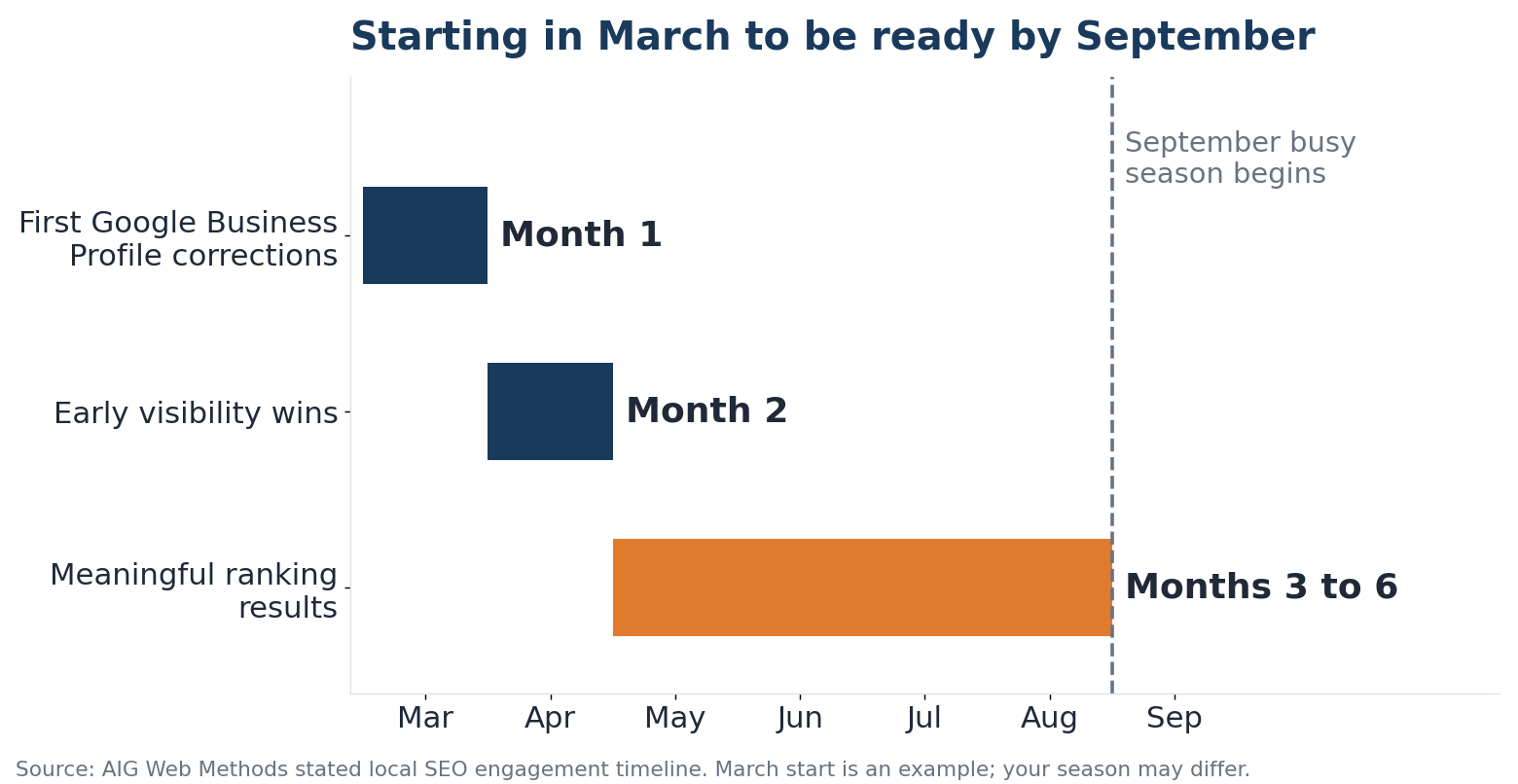
Our own stated timeline is first Google Business Profile corrections in month 1, early visibility wins by month 2, and meaningful ranking results in months 3 to 6. Working back from that, about six months ahead of your busy season is a sensible starting point.
If you are trying to figure out the right time to start or restart your marketing, we are happy to walk through your business and season with you. Call AIG Web Methods at (215) 999-6120, email admin@aigwebmethods.com, or set up a free 30 minute strategy call.