

What should you look for in a marketing agency contract? Five things decide whether the agreement protects you: who owns the website, domain and content; how “results” are defined and reported; how long the term runs and what it costs to leave; whether ad spend is separated from agency fees; and whether you keep owner access to your Google Business Profile, ad accounts and customer lists. This guide from AIG Web Methods walks through each clause in plain language so a small business owner in Philadelphia or the surrounding suburbs knows what to read closely before signing.
Hiring a marketing agency means handing over your website, your Google Business Profile, your ad budget and often your customer data to a company you may have met once on a video call. The contract is where that trust becomes something you can hold someone to. Most owners skim it, sign it and move on. That is usually a mistake, because the fine print decides who owns your website when you leave, how fast you can exit a bad fit, and whether “results” ever gets defined at all.
Who Actually Owns the Website and the Content
A common surprise is discovering, after leaving an agency, that you do not own your own website. Some agencies build on proprietary platforms or keep the login credentials under their own account, which means canceling service can mean losing the site.
Before you sign, look for language that spells out:
- Who owns the domain name registration
- Who holds the hosting account and the admin login
- Whether the site is built on an open platform like WordPress that you can move elsewhere, or a closed system tied to that agency
- Who owns the written content, photos and design files once they are paid for
The domain matters most, because the name on the registration decides who controls it. In its registrants’ benefits and responsibilities, ICANN, the organization that coordinates domain names, says the registrant “will assume sole responsibility for the registration and use of your domain name” and must keep the registrar account data current and answer registrar inquiries within fifteen days. If the agency is listed as the registrant, that control sits with the agency, not with your business.
A reasonable agency should have no problem stating in writing that the client owns the domain, the hosting account and the finished website. When a site is built on an open platform you can take with you, ownership stops being a negotiation.
What “Results” Actually Means in the Agreement
Marketing contracts often promise vague outcomes like “increased visibility” or “more leads” without defining what that means or how it will be measured. That vagueness protects the agency, not you. A contract worth signing ties the scope of work to specific, checkable activities: how many pages will be published, how often the Google Business Profile will be updated, how ad budgets will be tracked, and what reporting will look like.
Ask which metrics will appear in your reports and how often you will see them. A monthly report written in plain language, not a wall of jargon and screenshots, is a reasonable thing to expect and to name in the contract. If the agency does local SEO, ask how rankings in your own service area will be tracked, not just national averages.
Contract Length and How You Get Out
Term length is where much buyer’s remorse comes from. Some agencies lock clients into twelve month agreements with steep early termination fees, counting on most businesses not fighting the cancellation clause. Find the section that answers these questions directly:
- Is this month to month, or is there a minimum term
- How much notice do you need to give to cancel
- Is there an early termination fee, and how is it calculated
- What happens to work in progress if you cancel mid month
Match the Term to How Long the Work Takes
Term length should also match how long the work takes to show results. The chart below uses the timeline AIG Web Methods states for its own local SEO engagements: first Google Business Profile corrections in month 1, early visibility wins by month 2, and meaningful ranking results in months 3 to 6.
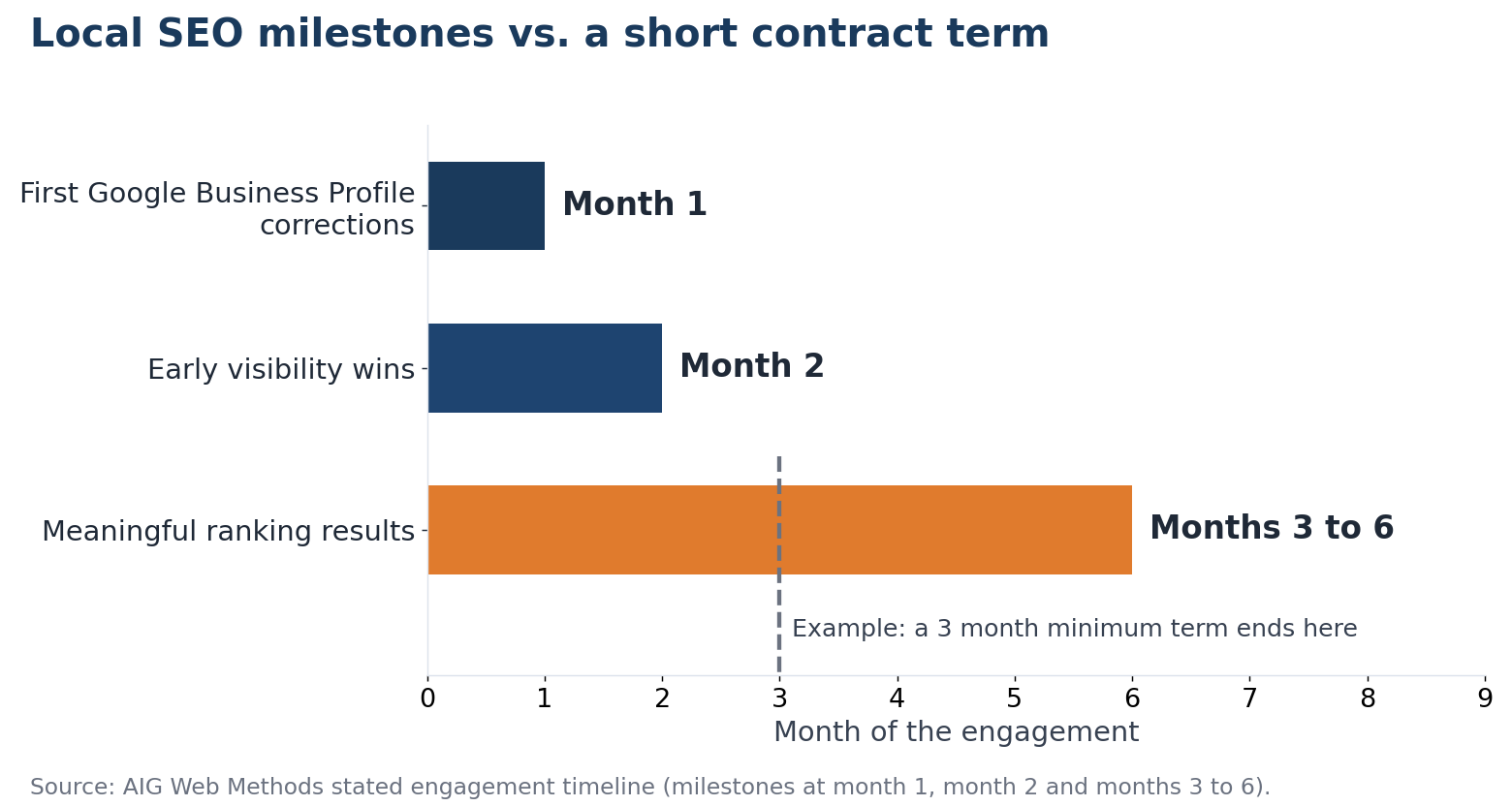
The takeaway cuts both ways. A very short minimum term can end before ranking work has had time to show up, so judge an agency on whether the early milestones actually happened, not on month 3 rankings alone. And a long lock-in is only reasonable if it comes with a clear exit clause and a remedy period for missed work. A month to month arrangement, or a short initial term with an easy exit, keeps the pressure on the agency to earn your business every month.
Ad Spend, Fees, and Where the Money Goes
If the contract includes paid advertising such as Google Ads, check whether the agency’s management fee is separate from your actual ad spend, and whether that split is written down. Some agencies blend the two into a single invoice, which makes it hard to tell how much of your budget reaches potential customers and how much covers the agency’s markup.
Look for:
- A separate line for ad platform spend and another for agency management fees
- Access to the ad account itself, not just a summary report the agency generates
- Whether unused ad budget rolls over or disappears at month end
Data, Login Access, and What Happens When You Leave
Your Google Business Profile, your website, your email and text marketing lists and your ad accounts all hold data and history with value of their own. A contract should state plainly that you keep administrative access to your own accounts, or at minimum that full access and data exports are handed over promptly if the relationship ends.
This matters most for customer contact information, such as email and SMS marketing lists built up during the engagement. If the list of customers who opted in to your texts or emails cannot be exported and handed to you, you start from zero with the next vendor, no matter how long you worked with the last one.
What Happens if the Work Is Not Delivered
Look for a section that covers missed deadlines, undelivered work, or a relationship that is simply not working. Reasonable contracts include a remedy period: a defined window to fix a problem before either side can walk away without penalty. If a contract has no way to address missed deliverables short of full termination, ask about it directly before signing.
Google Business Profile Ownership
For a local business, the Google Business Profile is often more valuable day to day than the website, since it is what shows up when someone searches nearby. The role your agency holds on that profile matters. Google’s own help page on Business Profile owners and managers explains that an owner has full control, including adding or removing users and deleting the profile, and that a profile has only one primary owner. Managers have mostly the same access, except they cannot add or remove users or remove the profile.
Owner vs. Manager: Which Role the Agency Should Hold
That is why the contract should say your business stays the primary owner and the agency is added as a manager, not the other way around. If an agency holds primary ownership, it controls who else can get in, and getting the profile back can be slow. Before signing anything involving local SEO or Google Business Profile management, confirm this in writing.
Questions to Ask a Marketing Agency Before You Sign
If you only have ten minutes before a contract meeting, ask these questions out loud and get the answers in writing:
- Who owns the website, the domain and the content after this contract ends
- What is the minimum term and what does canceling early cost
- Will my business stay the primary owner of my Google Business Profile, ad accounts and marketing lists
- How often will I get a report, and will I understand it without a glossary
- What happens if the agreed work is not delivered on schedule
If any answer is vague, unwritten, or met with hesitation, treat that as useful information in itself. If automation is part of the proposal, ask the same ownership questions about any marketing automation workflows built for you.
Talk to AIG Web Methods about your situation.
Who Wrote This Guide for Small Business Owners
AIG Web Methods is a digital marketing agency in Huntingdon Valley, PA, serving small businesses across the Philadelphia area. Its founder brings 25 years of experience in enterprise IT at Vanguard, holds the CISSP security certification, and earned an MBA from Penn State. In enterprise technology, ownership of accounts and data is settled in writing before work starts, and that habit is where the checklist above comes from. Clients talk to the founder directly, not a coordinator or a sales rep, and get a monthly plain-English report, the same standard this guide suggests you ask for from any agency, whether or not you end up working with us.
Talk Through Your Contract on a Free Strategy Call
Tell us about your business and the agreement you are weighing. We will set up a free 30 minute strategy call to go through ownership, term length, fees and reporting with you. Your information is never shared.
Frequently Asked Questions
Should a marketing agency contract be month to month or a longer term?
Either can work. A longer term should come with a clear early termination clause and a remedy period if deliverables are missed. Month to month agreements keep ongoing pressure on the agency to perform, which many small business owners prefer.
Who should own my website if I hire an agency to build it?
You should. The contract should state that your business owns the domain registration, the hosting account and the finished website, ideally built on an open platform that can move to another host or developer later without starting over.
What happens to my Google Business Profile if I switch agencies?
If your business is the primary owner and the agency is only a manager, switching is simple: you remove the agency. Google says only owners can add or remove users, so if the agency holds primary ownership, getting the profile back can be slow. Confirm ownership in writing before signing.
How should ad spend be separated from agency fees in a contract?
Look for a contract that lists the amount going to ad platforms like Google Ads separately from the agency's management fee, plus access to the live ad account so you can check spend yourself instead of relying only on a summary report.
What should a monthly marketing report include?
A useful report explains what work was done, what changed as a result and what is planned next, in language you can follow without a marketing background. If a report is mostly charts and jargon, ask the agency to walk you through it before you sign anything long term.
If you are reviewing a marketing contract right now or getting ready to sign one, AIG Web Methods offers a free 30 minute strategy call to talk through what to expect, with no obligation. Call (215) 999-6120 or email admin@aigwebmethods.com to set up a time.